“We should never have 100% client satisfaction”

A friend forwarded me this great article from Jesse Lipson at Forbes, applying Taleb’s concept of antifragility to business. The author encourages entrepreneurs to cultivate a work environment where people will “embrace volatility,” “fail frequently in small ways,” and “build back even stronger.”

“So in Antifragile,” writes Lipson,

Taleb suggests we stop trying to predict the future and focus on protecting against something that we can more easily measure: fragility. Something is fragile if it breaks with small changes in the environment: a wine glass shatters if you drop it; it’s fragile. If an object or system can withstand large changes, it’s resilient. A system is antifragile if it actually thrives on chaos, growing stronger when the unexpected occurs.

It’s like weightlifting: Your company is antifragile when it’s composed of more muscle than bone. Yes, bones can recover from a break, but often in a weakened state. A muscle is strengthened by damage. Weightlifters build muscle by pushing it past the limit. A stressed muscle is riven with tiny tears and, as the muscle repairs itself, it actually rebuilds stronger and bigger than before.

This morning, I forwarded the article along to some other entrepreneurs, and one responded thusly (I paraphrase):

Thinking about this, we should never have 100% client satisfaction. We should be doing little experiments all the time, and experiencing little failures here and there, with the result being that a small percentage of clients isn’t happy. If we don’t do that, none of our clients will ever be ecstatic.

I love that observation, even as someone who makes a living monitoring customer satisfaction. If 100% of our clients will recommend us, then we’re never failing to meet expectations, and that suggests we’re not taking enough small risks to keep driving our business forward in an enduring (and antifragile) way.
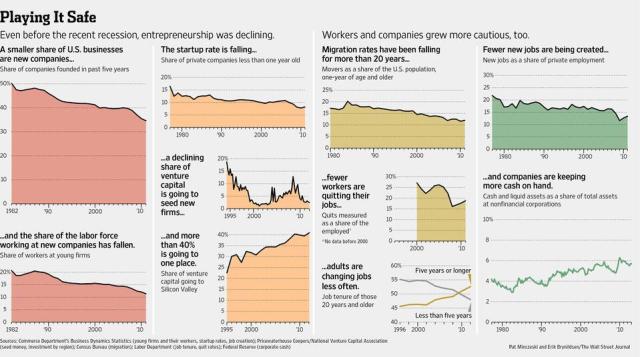
Why is entrepreneurship on the decline?

WSJ: Decline of Entrepreneurship

A couple weeks ago, Ben Casselman of the WSJ presented some trends about entrepreneurship in the United States. Nowadays, he writes,

Companies add jobs more slowly, even in good times. Investors put less money into new ventures. And, more broadly, Americans start fewer businesses and are less inclined to change jobs or move for new opportunities.

The changes reflect broader, more permanent shifts, including an aging population and the new dominance of large corporations in many industries. They also may help explain the increasingly sluggish economic recoveries after the past three recessions, experts said.

Stephen Bainbridge added some thoughts as to why entrepreneurship is declining. He writes, “First, the dearth of US citizens pursuing careers in science and engineering. Second, the impact of law and regulation.” A lot of folks seem to be echoing his first point. I don’t buy it, and will share more about why at the end of this post. But, I completely agree about the second point. Bainbridge elaborates:

When you add up the growing costs of regulation and the growing risk of litigation, there’s no wonder smaller firms and start ups struggle. Only big firms can achieve the sort of economies of scale that make such costs bearable.

Regulation and litigation are absolutely stifling the growth of new businesses, and completely favoring large, established corporations. I’ve written some about that (here and here and here and here), and many other people have as well. Even so, all the bellyaching doesn’t seem to be altering the growth trajectory of litigation and regulation.

Here are a few more reasons why I believe entrepreneurship is on the decline:

Continue reading “Why is entrepreneurship on the decline?”

Entrepreneurship is the launching of surprises

Many years ago, I read Kevin Kelly’s New Rules for the New Economy, and that got me thinking seriously about building an internet business. Since then, I’ve found that all sorts of interesting people seem to point me back to his website for some interesting thoughts about interesting things. After one such pointing, I checked out his collection of sourced quotes and spotted one from George Gilder (I used the quote as the title of this post) pointing to this article about entrepreneurs and the creation of wealth. The internet is pretty cool.

I regularly find myself attempting to and failing to explain the importance of entrepreneurship and how entrepreneur means something different than business person or capitalist. Well, yes, entrepreneurs are often business people and might even describe themselves as capitalists, but seldom is a capitalist or a business person an entrepreneur. Entrepreneurs are, in fact, very rare and getting rarer.

One day a couple years ago, I got annoyed by so many people describing themselves as entrepreneurs–feeling that it dilutes the value and meaning of the career–that I tried to wrap some definition around the phrase. I much prefer the way Gilder characterizes entrepreneurship. It’s more than simply making new stuff work; entrepreneurship is about enabling prosperity.

I love how he differentiates between wealth creation and wealth extraction. Some wonderful excerpts:

Continue reading “Entrepreneurship is the launching of surprises”